

Yesterday, an AI agent booked a house viewing in your name.
It pulled your salary from your bank account, checked your credit score, synced your calendar, and negotiated a viewing slot with another agent. You did not click “approve” on each step. You just said, “Find me a place and handle the logistics.”
That is not a simple automation script or a background service account. That is an identity that acts on your behalf.
We already know how to think about two types of identities:
Human identities: users like you and me.
Machine identities: services, APIs, and scripts that keep our systems running.
Now we are adding a third category that behaves very differently: agentic identities. These are AI-driven entities, usually powered by large language models, that act with autonomy, adapt to context, and make decisions in real time.
As these agents become part of real products and workflows, they challenge how we design identity and authorization. Machine identities are predictable and usually short-lived, built for specific repetitive tasks. Human identities are non-deterministic but tied to real people and real accountability. Agentic identities mix the worst and best of both worlds: they are non-deterministic and often ephemeral, with deep access and little friction.
They are not just tools. They are personalized delegates that can talk to other systems, other agents, and other humans, at scale.
In this article, we will:
Break down human, machine, and agentic identities.
Explain why agentic identities will explode in volume and criticality.
Show how modern authorization, and specifically Permit.io, can keep these agents safe, accountable, and under control.
The Identity Spectrum: Human, Machine, and Agentic
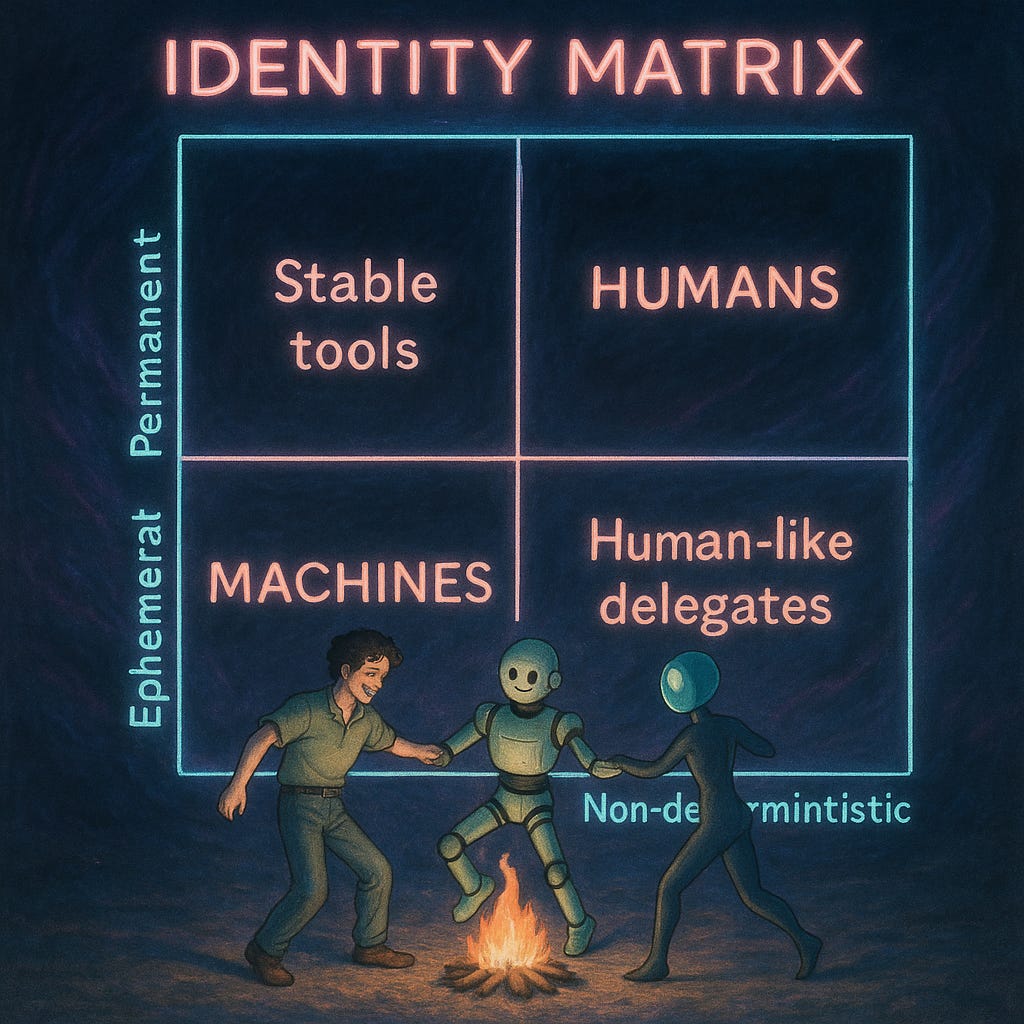
To understand what is coming, it helps to put the three main identity types on the same map.
At a high level:
Humans: non-deterministic and relatively permanent.
Machines: deterministic and typically ephemeral.
Agents: non-deterministic and often ephemeral, usually tied 1:1 to a human.
Human identities: Non-deterministic and accountable
Human identities are the ones we have worked with the longest. They represent real people interacting with applications and services.
Key traits:
Non-deterministic behavior: the same user might act differently tomorrow, or in a different context.
Persistent accounts: user accounts tend to live for months or years.
Accountability and context: there is legal, HR, and business context around what a person is allowed to do.
In authorization terms, we usually assign roles, permissions, and attributes to humans. Models like role-based access control (RBAC) and attribute-based access control (ABAC) let us express policies such as:
“Support agents can view customer tickets but cannot see full card numbers.”
“Managers can approve expenses above a given threshold.”
Human identities are where least-privilege, approvals, and auditability first became mainstream concerns.
Machine identities: Deterministic workhorses
Machine identities emerged with the rise of cloud computing, APIs, and microservices. These are service accounts, scripts, daemons, and bots that do automated work.
Key traits:
Deterministic behavior: given the same inputs and code, you expect the same outcome.
Often ephemeral: containers or jobs spin up, do their work, and vanish.
Infrastructure-centric: they move data, run background jobs, or glue systems together.
Examples:
A service account that syncs rows between two databases.
A background worker that resizes images.
A CI pipeline that deploys a new version of your application.
The security story here focuses on:
Certificates and OAuth clients.
Short-lived tokens and secret rotation.
Static, predefined policies to limit blast radius.
These identities are “wholesale”: one machine identity might handle requests for many users at once.
Agentic identities: Non-deterministic, ephemeral delegates
Agentic identities are the wildcard in this spectrum.
Powered by AI systems like large language models, these identities are:
Non-deterministic: they interpret instructions, improvise, and adapt to context.
Often ephemeral: they can be spun up per user, per session, or even per task.
User-centric: they often exist to serve a single human, almost like a digital employee or assistant assigned 1:1.
Examples:
A home-buying agent that talks to banks, real-estate APIs, and other agents.
A customer support copilot that answers tickets and takes actions in your CRM.
A financial planning agent that can move money between accounts under constraints.
Unlike traditional machine identities, these agents:
Do not simply “run a script.”
Participate in conversations.
Delegate to other agents.
Make choices that you did not explicitly hardcode.
This creates new patterns such as:
Human to agent handoff: you set goals, the agent executes.
Agent to agent collaboration: your agent negotiates with another agent that represents a seller, lender, or provider.
One agent per user: instead of one service identity serving thousands, you might have tens of thousands of agents, each tightly linked to a single human.
Why “Non-human identities” is not enough
You will often see the term “non-human identities” (NHI) used to describe machine and agentic identities together.
It is convenient, but it is also dangerous.
Machines are predictable tools. Agents are unpredictable delegates. If you secure them the same way, you are going to have a bad time.
We should instead distinguish based on behavior:
Deterministic identities: mainly machines.
Non-deterministic identities with agency: humans and agents.
That framing is much closer to how risk actually behaves in your system.
Why Agentic Identities Transform Authorization
Agentic identities are not just another label. They fundamentally change how many identities you manage, what they can do, and how badly things can go wrong.
Here are three reasons why they matter so much.
1. Volume: One or more agents per user
In a traditional machine-dominated world:
One service might handle traffic for thousands or millions of users.
In an agentic world:
You might have one or more agents per user, per environment, and possibly per use case.
If you have 10,000 users today, you might soon have tens of thousands of agents, each with its own identity and relationship to resources.
Authorization systems now need to:
Issue and manage permissions for huge numbers of ephemeral identities.
Do it without performance regressions and without collapsing under policy sprawl.
2. Criticality: Agents handle decisions, not just data
Agents do not just move data or run background tasks. They make decisions that look a lot like human decisions.
In the home-buying scenario:
Your agent might access:
Bank data.
Employment records.
Calendars.
Real-estate APIs.
It then coordinates with other agents working for sellers or lenders.
A single overly broad permission can lead to:
Privacy violations.
Fraudulent actions.
Commitments you did not intend to make.
Traditional machine identities handle processes. Agentic identities handle judgments. That raises the stakes.
3. Unpredictability: Non-deterministic behavior is harder to fence
Machines:
Run code paths that you can trace and test.
Make the same decision for the same input.
Agents:
Are guided by prompts, context, and internal model behavior.
Might interpret “optimize my savings” as “cancel insurance policies that look redundant.”
Can surprise you even when you think you were clear.
This means authorization models must:
Consider context (who is the agent acting for, what is the current risk).
Capture relationships (which user or organization does this agent represent).
Support real-time evaluations instead of only static role checks.
Models like relationship-based access control (ReBAC) are especially powerful here: they let you define access not just by roles or attributes, but by how entities are connected.
Rethinking Categories: Identities With and Without Agency
Instead of grouping identities as “human” vs “non-human,” it is often more useful to ask:
Is this identity deterministic or non-deterministic?
Does it have agency on behalf of someone else?
From that perspective:
Deterministic identities:
Machines and services.
Best handled with predefined, static policies.
Non-deterministic identities with agency:
Humans and agents.
Need policies that adapt to context and delegation paths.
For non-deterministic identities, authorization must support:
Delegation: user to agent, agent to other agents, nested delegation.
Context-aware constraints: time windows, resource ownership, risk signals.
Traceability: being able to answer “who did what on whose behalf and why.”
This is where a lot of the existing “NHI” conversation falls short. It ignores the fact that human-like agency, even when implemented in silicon, needs a different security model than a cron job.
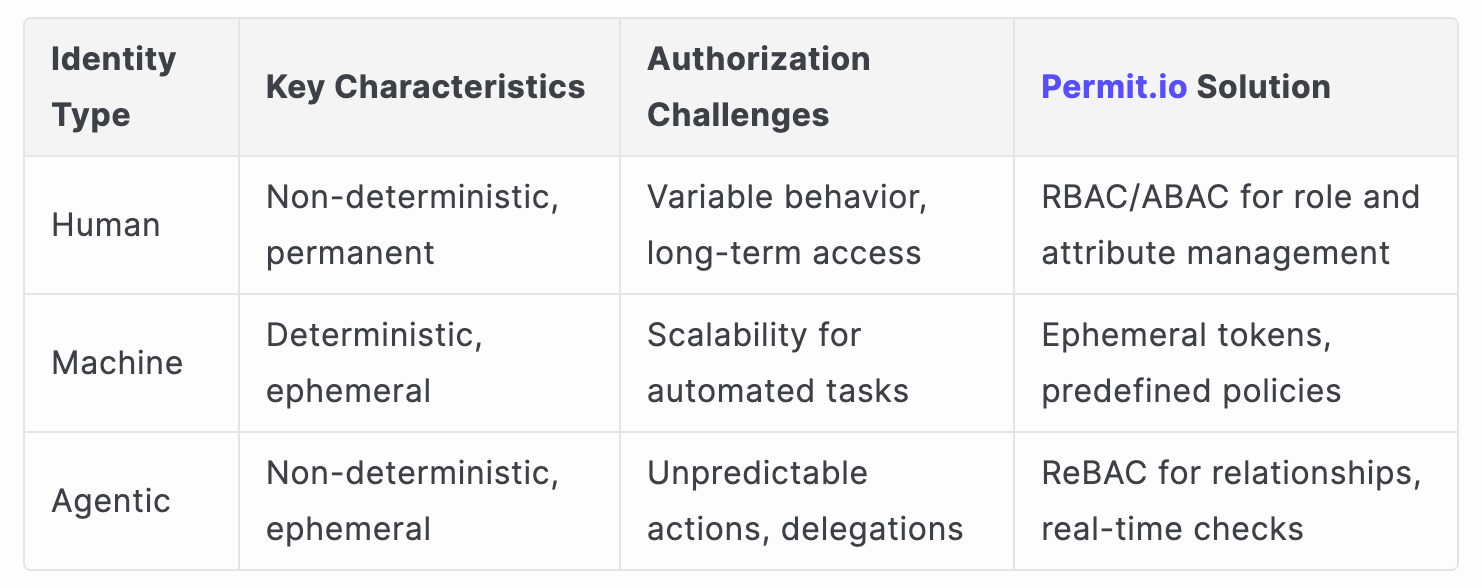
To illustrate, consider a table comparing identity types and their authorization needs:
How Permit.io Handles Agentic Identity Authorization
This is where modern authorization platforms come in. Permit.io is built to handle exactly this pattern: human users, machine services, and now tens of thousands of agents acting on behalf of those users.
Imagine a customer-facing AI copilot in your SaaS product:
Each user gets their own agent.
That agent should:
Only see what the user can see.
Only perform actions the user is allowed to perform.
Leave a clear audit trail of every decision.
Permit.io lets you design this in three main layers.
1. Modeling: Users, agents, and delegations
Permit.io supports RBAC, ABAC, PBAC, and ReBAC, so you can represent:
Users and their roles.
Agents and their relationship to users.
Resources and who owns them.
Delegation rules between all of the above.
For example, you can express policies like:
“An agent can only access resources owned by the user it represents.”
“Agents inherit a subset of their user’s permissions.”
“Delegation is limited in time or scope.”
2. Enforcement: Real-time checks in the agent’s execution path
You then enforce these policies through SDKs and local policy decision points (PDPs) that sit close to your agents.
In pseudocode, a check might look like:
// Agent acts on behalf of a user
const allowed = await permit.check({
  user: {
    type: “agent”,
    key: agentId,
    attributes:{actingOnBehalfOf: userId}
  },
  action: “schedule_viewing”,
  resource: {
    type: “listing”,
    key: listingId
  },
});

if (!allowed) {
  throw new Error(”Agent is not allowed to schedule this viewing.”);
}
Under the hood, Permit.io can:
Run PDPs locally for zero or near-zero latency decisions.
Keep policies and data synchronized using a hybrid architecture built on OPAL.
Integrate with your existing identity provider to sync users, groups, and attributes.
3. Auditing: Traceable actions in agent-heavy environments
In an agentic world, auditability is not optional. You must be able to answer:
“Which agent took this action?”
“Which user was it representing?”
“Which policy approved that decision?”
Permit.io provides comprehensive audit logs for authorization decisions, so you can trace:
Every
permit.checkcall.The principal (user or agent) and its relationships.
The policy that granted or denied access.
This is critical for:
Compliance in regulated environments.
Incident response and forensics.
Building trust with your users when agents act on their behalf.
You can explore more about policies and auditing here:
ReBAC policies: https://docs.permit.io/overview/create-a-rebac-policy
Audit logs: https://docs.permit.io/features/audit-logs
Preparing for an Agentic World
Agentic identities are not a distant future idea. They are already showing up as:
Copilots inside developer tools and SaaS apps.
AI helpers for finance, HR, and operations.
Autonomous agents orchestrating multi-step workflows.
They blend human-like agency with machine efficiency, and that demands a fresh approach to authorization.
If we move beyond vague terms like “non-human identities” and instead focus on behavioral traits like determinism, ephemerality, and delegation, we can design systems that:
Scale to millions of ephemeral agents.
Keep agents within strict, understandable boundaries.
Preserve a clear chain of responsibility for every action.
The agents are already here. They just have not been modeled correctly in most IAM and authorization setups yet.
Getting this right is where platforms like Permit.io come in. You do not need to reinvent authorization every time you spin up a new class of agents. You can lean on proven patterns and infrastructure and focus on the product and user experience.
If you are prototyping or already shipping AI agents:
Dive into the Permit.io docs for examples on ReBAC and delegation.
Explore our GitHub repositories for integration samples.
Reach out to us to walk through a reference architecture for your specific agent use case.
As AI agents proliferate, authorization will become the difference between powerful, trusted assistants and dangerous, uncontrollable ones.
Let us make it powerful and seamless, not scary.
Until next time,
Or
Agentic identities mixing 'the worst and best of both worlds' is the right framing. The Kiro incident on AWS proved this exactly. The agent inherited a senior engineer's permissions and didn't need them all, but nobody had built the access model to distinguish between a human's judgment and an agent's literal task completion drive. Wrote about the governance gap here: https://reading.sh/whos-liable-when-your-ai-agent-burns-down-production-039193d82746?sk=4921ed2dbc46f0c618835ac458cf5051