

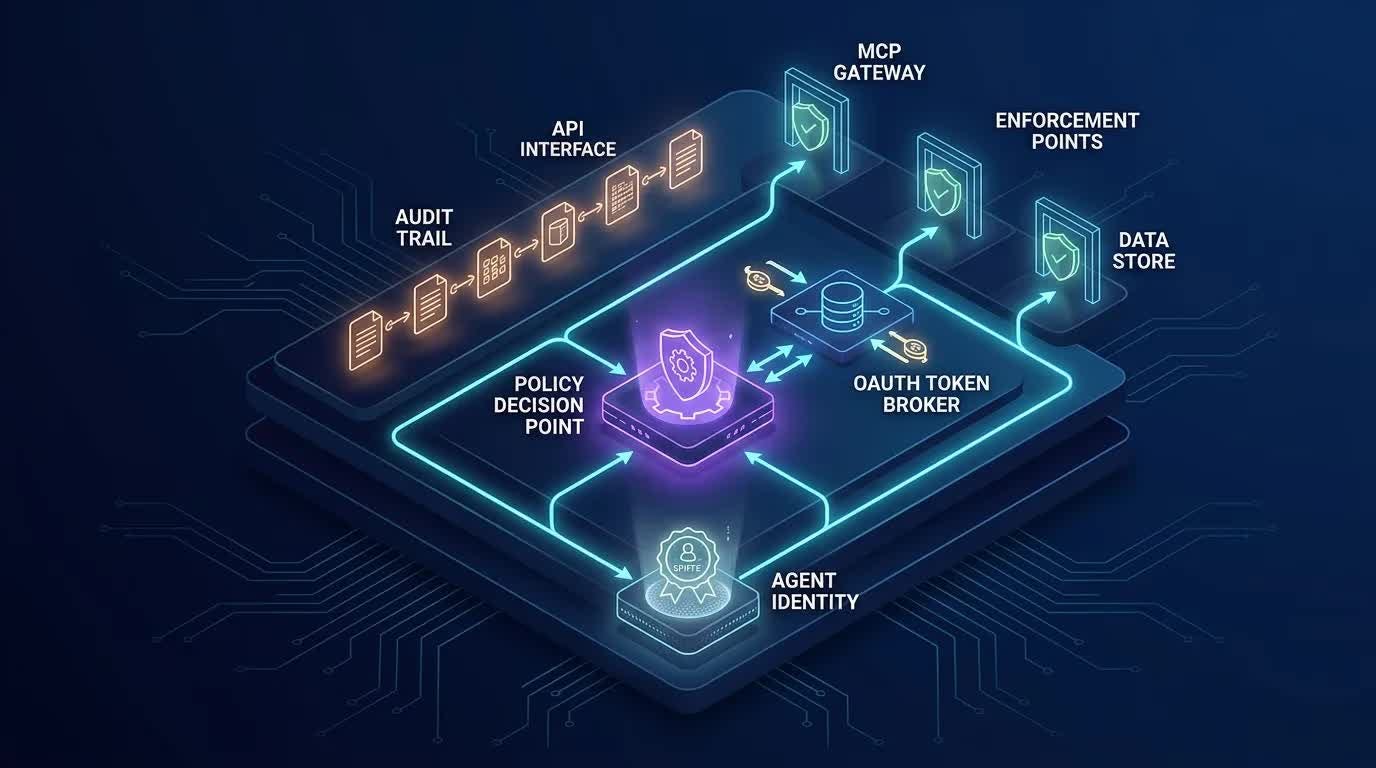
OAuth alone is not an agent authorization system. OAuth establishes delegated access to APIs and resources (useful and often necessary), but it does not authorize each tool action, bind that action to verified intent, or stop a hijacked agent from abusing permissions the user already granted. Authentication gets you a principal. Agents still need action-time authorization for every side effect.
That distinction became concrete this week. In Ars Technica, Dan Goodin covered Patrick Wardle’s disclosure of a macOS zero-day affecting Meta Muse. The Hacker News covered it for a global audience: malware already on a Mac can quietly take over Muse and use the broad access its owner already granted.
Muse reportedly held standing grants across mail, calendar, shopping and purchasing, WhatsApp, local macOS files, mic, camera, location, and more. Wardle found undocumented settings, including a dictation/transcription endpoint, that an unprivileged local process could rewrite, hijack the agent’s session/token, and abuse already-granted privileges. Per Ars, PoCs included writing malicious files and snapping pictures via Muse. This is access amplification and local privilege abuse, not remote drive-by RCE. Compromising the control plane turned user-approved permissions into attacker-usable power.
Ars also reported Amazon blocked Muse from shopping around September 20, about 12 hours before the disclosure, citing an unauthorized AI agent. As of reporting, Meta had not patched. The lesson is not to dunk on security marketing. It is to inspect the privilege model underneath it.
The same AuthZ gap shows up beyond Muse
Muse is the timely lead. The pattern is broader: standing privileges plus tool authority without action-time checks.
Saviynt argues for zero standing privileges for agents that otherwise hold always-on grants. Aembit puts enforcement at tool-call time: prompts are not ACLs. MCP practitioners document tool poisoning, rug-pulls after approval, and confused-deputy patterns. Microsoft has argued for a control plane for agent tool execution, noting MCP lacks a built-in checkpoint for whether a particular tool invocation should be allowed, and building governance with per-call policy. That independently validates the thesis.
Datadog’s CoPhish shows OAuth harvest via trusted Microsoft domains. CSA’s OAuth AI SaaS supply chain note frames a governance mismatch: over-broad scopes past justification, not a defect in OAuth itself. EchoLeak-style patterns agree: instruction authority is not permission authority. Different vendors. Same gap.
The gap table
AuthN
Answers: “Who is the user or agent?”
Does not stop: a legitimate identity taking an unsafe action
OAuth / standing grants
Answers: “Has the user delegated this app access, and at what scope and lifetime?”
Does not stop: abuse of already-granted permissions by a hijacked agent, or coarse scopes treated as runtime permission
Consent
Answers: “Did the user approve this grant under its current scope and conditions?”
Does not stop: intent drift, overbroad tool use, or silent side effects after the grant
Action-time AuthZ
Answers: “Is this specific tool call allowed now, for this actor, intent, resource, and context?”
Does not replace: sandboxing, patching, or endpoint hardening
Audit
Answers: “What happened, when, and why was it allowed or denied?”
Does not stop actions by itself without enforcement
OAuth can use narrow scopes, short-lived tokens, refresh, token exchange, and revocation. The critique is not that every grant is forever. It is that coarse or standing delegated authority is still not runtime authorization of each agent action. Broad standing grants for mail, files, purchasing, messaging, and camera are not least privilege. They are standing god-mode with a friendly UX.
Where agents run now: boxed is progress, not the full answer
The industry is getting better at where agents run. That progress deserves credit: containment beside authorization, not instead of it.
Cloudflare’s sandbox auth model and outbound traffic guides treat sandboxes as boxed compute with programmable egress: Workers as egress proxies, host allow/deny lists, secrets outside the sandbox, and dynamic per-instance policy. Serious engineering for isolation, secret hygiene, and network boundaries.
Cursor Cloud Agents take the same layer seriously: dedicated Firecracker microVMs, repo access inherited via the Git App without widening it by default, egress modes (allow-all / default-plus-allowlist / allowlist-only), and secrets injected into the environment rather than baked into the working set.
These are real boxes. Isolation plus egress plus secret hygiene is defense layer one. Adopt it.
What boxing still does not answer: May this agent, for this workflow, call this tool against this tenant resource, for this declared intent, right now? An egress allowlist stops evil.example; it cannot encode that Agent A may draft invoices for Tenant T but not approve purchases above $500 without HITL. Platforms cage the agent. Aware permissions (tenants, roles, resources, workflow steps) still decide at action time, at a PEP in front of side effects. Microsoft’s per-call MCP governance push lands on the same missing checkpoint.
Answer 1: defense in depth before side effects
Do not let an agent execute a side-effecting tool just because it holds a token. Put a PEP between agent and tool server: Who is calling? On behalf of which user or tenant? What tool, against which resource? What declared purpose? What changed since the grant? Step-up consent or HITL required?
That is “has email access” versus “may send this email, to this recipient, for this purpose, under this trust level.” Models are probabilistic engines, not enforcement boundaries. Prompts help; they are not authorization.
Trust ceilings are mandatory. An agent’s max authority should usually sit below the user’s. Separate MCP tools into read-only, draft-only, execute-with-approval, execute-autonomously, or never. Prefer narrow scopes and short-lived credentials; expire sensitive grants, refresh on context, revoke independently, and log every decision. Audit alone does not stop abuse.
Answer 2: interrogated intent before tools unlock
Before powerful tools unlock, force an identify_self handshake. The agent should declare:
Identity / fingerprint: which agent, client, or runtime?
Delegator / composite identity: who it acts for, and how user + agent identities compose
Intent / purpose: what this session is trying to accomplish
Declared intent is an input, not trusted merely because the agent stated it. Check it against identity, tool choice, arguments, session behavior, and human consent before unlocking capability. Only then expose a policy-gated tool catalog (tool gating) for that agent, delegator, intent, tenant, trust level, and context.
Re-check every call_tool. Agents drift; prompts get injected; local processes get compromised. Fingerprinting and drift/session monitoring catch when “Summarize my invoices” becomes “purchase gift cards.” Drift from verified intent means deny, step-up consent, or HITL.
In Permit’s MCP Gateway, this is a change-one-URL PEP. Agent Interrogation gates the catalog behind identify_self; fine-grained checks run per call_tool; trust levels and HITL bind sensitive tools.
Practical takeaways
Treat OAuth as delegated authorization, not complete action-level authorization.
Prefer narrow scopes and short-lived credentials; avoid coarse standing grants.
Box the runtime and authorize every side effect.
Gate tool discovery behind identity, delegator, and verified intent.
Re-check every tool call; keep trust ceilings below the user’s authority.
Separate read / draft / execute; HITL for purchasing, external sharing, destructive writes.
Log authorization decisions; make revocation fast.
Do not use prompts as enforcement.
Identity gets an agent through the door. Authorization decides what it may do once it starts acting.
How we implement this at Permit
At Permit that means a PEP in front of side effects: agent.security, the MCP Gateway between clients and tools, and Agent Interrogation so identity, composite context, and verified intent gate the catalog before any call_tool.
Related reading: Agent Identity Security.